Dispatch in multiple sheets
Nobody is sure which spreadsheet or whiteboard has the current load status.
TMS for small carriers
Hawk Lane is a small fleet TMS for asset-based carriers managing about 2–20 trucks, with one cloud workspace for loads, dispatch, drivers, equipment, documents, PODs, invoicing, and reporting.
Start with the core workflow your fleet needs today. Add the driver app, customer portal, settlements, guided setup, and supported integrations as your operation grows.
Free for up to 3 trucks · Growth for up to 10 · Pro for up to 20 · Browser-based · No per-load pricing
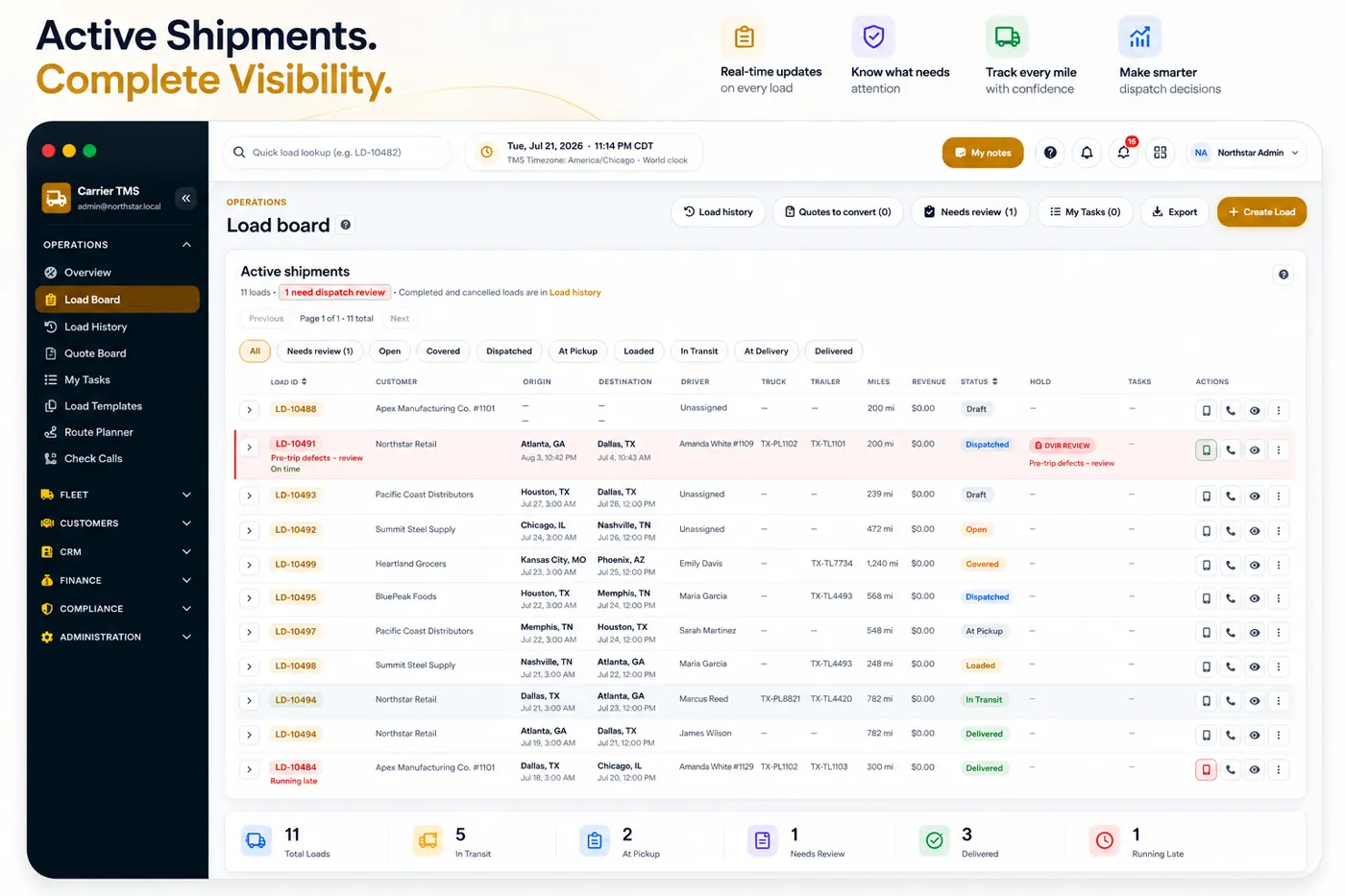
A small fleet TMS is transportation management software designed to connect daily carrier operations — dispatch, driver and equipment assignments, documents, PODs, invoicing, settlements, and reporting — without enterprise-level complexity. Hawk Lane is built for asset-based fleets of about 2–20 trucks. Request Free Access for up to 3 trucks; access is reviewed, not instant.
A small trucking company can run its first loads with spreadsheets, phone calls, texts, and email. The problems begin when dispatch details, driver updates, PODs, invoices, and settlement notes stop matching.
A TMS for small carriers should create one operating record for each load without requiring an enterprise implementation. Dispatch should know what is moving, drivers should know what is assigned, documents should stay with the load, and billing should not rebuild the same information after delivery.
Nobody is sure which spreadsheet or whiteboard has the current load status.
Pickup, delivery, and delay updates are buried in personal message threads.
Delivery documents arrive in email or camera rolls and delay invoicing.
The office re-enters rates, expenses, advances, and deductions after the load is complete.
Small carrier TMS software should connect the full load workflow. It should not be only a vehicle tracker, accounting tool, or load board.
Create loads, capture customer and lane details, manage stops and appointments, and see active and completed work from one dispatch view.
Assign the driver and equipment to the correct load so the office can see responsibility and availability without cross-checking separate files.
Keep rate confirmations, BOLs, PODs, receipts, and supporting documents attached to the load where dispatch and billing can find them.
Move delivered loads toward invoicing using the information and paperwork already captured. Driver settlements are available on Growth and above.
Growth and higher plans add the driver app and customer portal so updates and shared visibility do not depend only on phone calls.
Small trucking company software should match the size of the operation. Start with the core workflow, then add driver, customer, reporting, and integration capabilities as the fleet grows — the same account, wider scope.
If you drive and run the office yourself, or you mainly need loads, PODs, BOLs, receipts and expenses on your phone, you can use the TMS App. Move to Carrier TMS when you need a dispatch board, invoicing and settlements in the browser.
Use the Free plan for core web TMS, loads, dispatch, documents, PODs, basic invoicing, and self-guided setup. This stage is for carriers that want to replace scattered tools and run real loads without paying for collaboration features they do not need yet.
Growth adds the driver app, customer portal, driver settlements, standard reporting, guided initial setup, and priority email support. It is designed for fleets where more people need to work from the same load record.
Pro adds advanced reporting, priority onboarding, one standard master-data migration, and one supported standard integration of your choice — QuickBooks Online, Motive, or Samsara — subject to setup and compatibility review. Switching from another TMS or spreadsheets? Ask about data migration. Share a sample export and we'll confirm what can be imported, the timeline and any setup cost before you switch.
AI Dispatcher available
Start with standard Carrier TMS for loads, dispatch and documents. When weekly tenders make copy-paste expensive, AI Dispatcher can prepare reviewable drafts from voice, OCR on supported PDFs, CSV mappings or authorised email. It is separately quoted and is not required to run the Free, Growth or Pro plans. See optional TMS workflow automation.
The goal is not to add more software to a small carrier. The goal is to stop entering and searching for the same load information in multiple places.
Customer, lane, rate, equipment, stops, and appointments.
Connect the truck, trailer, and driver to the load.
Record pickup, in-transit, delivery, check calls, and exceptions.
Attach rate confirmations, BOLs, PODs, and receipts.
Use completed load information and delivery documents.
Paid plans support settlements and stronger reporting.
Hawk Lane is independent cloud-based trucking software for carrier operations. It is not a load board, freight marketplace, dispatch service, government agency, FMCSA service, or authority-filing provider.
Hawk Lane Tech provides independent cloud-based transportation management software. We are not affiliated with FMCSA or any government agency and do not obtain USDOT, MC, or operating authority on a carrier’s behalf.
Pricing is based primarily on active truck count — not per driver or per load. Free is $0/month up to 3 trucks, Growth $99/month up to 10, Pro $199/month up to 20, and Custom is quoted for larger fleets. The complete plan comparison is on TMS software pricing.
These pages cover different questions. This page is about product fit by fleet stage — not a category definition or a comparison checklist.
Category explainer: what a trucking TMS does from dispatch through documents, PODs, invoicing, and settlements.
Buyer guide and evaluation checklist — what to compare before you pick a system.
Dispatch-board detail: assigning drivers and equipment, check calls, and moving loads into invoicing.
Operating the fleet itself: fleet-wide load visibility, truck and trailer records, driver assignments, and load profitability.
A small fleet TMS is transportation management software designed to connect daily carrier operations—dispatch, driver and equipment assignments, documents, PODs, invoicing, settlements, and reporting—without requiring enterprise-level complexity.
Hawk Lane is focused on small and growing asset-based carrier fleets. Free supports up to 3 active trucks, Growth up to 10, Pro up to 20, and Custom covers larger or more complex requirements.
Yes. The Free plan is $0 per month for up to 3 active trucks and 2 staff users. It includes core web TMS, loads, dispatch, documents, PODs, basic invoicing, and self-guided setup. No credit card is required during the pilot. Submit the request on the Free Carrier TMS page — access is reviewed, not instant.
No. The driver app, customer portal, and driver settlements are included on Growth and higher plans. Integrations are not included on Free or Growth.
No. Hawk Lane is not a load board or freight marketplace. It helps an asset-based carrier manage operations after a load is booked.
Hawk Lane can replace many spreadsheets used for load dispatch, assignments, documents, PODs, invoicing, and settlement workflows. A carrier should begin with a few real loads and confirm the workflow before moving more of the operation.
No. Hawk Lane is cloud-based and accessed through a supported web browser. No desktop software download is required.
Yes. Pro includes one supported standard integration, and QuickBooks Online is one of the options alongside Motive and Samsara. Setup and compatibility requirements apply. See QuickBooks TMS integration.
Start with Free for up to 3 trucks. Upgrade when your fleet needs the driver app, customer portal, settlements, guided setup, advanced reporting, or a supported integration.
Request Free Access means submitting the existing review form. It is not instant account creation.